
Blog
What do your shareholders really think? How to apply NPS to an equity crowdfunded company
Do investors care about my business?
Hubbub has raised multiple rounds of funding over the years, from friends and family, to angels, through crowdfunding, and more recently through venture capital. In this post I explain a new approach we have been using to investor engagement.
We have tried all sorts of ways to engage shareholders in what we do: newsletters, AGMs, even Facebook groups and Slack communities. The biggest issue we faced was not really knowing whether what we were doing was actually helping. How do we know that the 200+ investors we have actually care, or engage with what we say? How do we know if they will talk about their investment to others? How do we know if we are meeting their expectations? With those answers we can plan activities that keep them engaged, rather than spending time and money on things that might not move the needle.
This matters because, as a B2B SaaS company, most of our clients pay close attention to recommendations and reputation. A substantial proportion of clients were introduced by someone: an investor, partner or current customer. So if we can get shareholders actively engaged, it will make a fairly immediate impact on our bottom line.
Shareholder NPS?
Across the business we have been exploring the Net Promoter Score methodology more widely. It is how we would normally track whether what we are doing actually works, for customers, suppliers and for our own team, so it seemed appropriate here too. A lot of the value from NPS comes from the qualitative follow-up: “Why did you give us that score?”
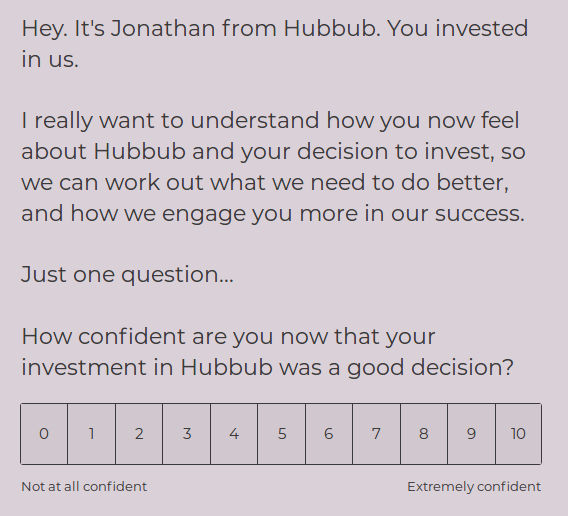
To apply NPS to shareholders, you first have to ask what you want them to do. We want them to support us in future, by signing papers quickly, giving consent for further share issues, or investing again, and we want them to bring us customers and promote Hubbub. That is a complex series of behaviours, so what is the binding question underneath? I settled on: “How confident are you now that your investment in Hubbub was a good decision?” High scores on that question are likely to lead to the behaviours we want, and low scores the opposite, so it is a metric worth tracking and optimising alongside the qualitative feedback.
How long does this take?
I was convinced there was a simple way to run this freely and with minimal time. I built the survey using Typeform’s templates in a few minutes, gathered investor contact details into a spreadsheet, and emailed the question out. Typeform’s HTML email block works fine with the Thunderbird desktop client via Insert then HTML. Putting 40-odd addresses at a time into the BCC field meant I only had to send six emails to cover the whole investor pool. Clicking an answer took investors to a follow-up “Why did you choose X?” question, and I logged the results into a Google Sheet by hand.
The results
We left it three weeks. We had 55 respondents, 26% participation, an average score of 6.6 and an NPS of -20. Not bad, considering the last investor newsletter went out nearly nine months earlier and most investors put money in four or more years ago. More importantly, we had clear themes for what investors wanted in order to score us higher: Information, Exit Strategy and Valuation. The actionable ones were simple: show financial performance, show monthly recurring revenue and pipeline growth, and show people our successes such as new clients and big launches. The whole process, end to end, was about two hours of work, and I scheduled it to repeat every two months.
Should others do this?
Absolutely. Beyond the direct actions to improve relationships, simply showing that we care what people think has already re-engaged shareholders who invested a while back but had gone quiet. It also helped us build the infrastructure for collecting NPS rapidly in other areas, which has led to valuable insights across the business. This is probably only worthwhile if you have 20 or more investors; below that, just give them a ring every quarter. But for anyone who has been through crowdfunding, do it.